Address
304 North Cardinal St.
Dorchester Center, MA 02124
Work Hours
Monday to Friday: 7AM - 7PM
Weekend: 10AM - 5PM

Address
304 North Cardinal St.
Dorchester Center, MA 02124
Work Hours
Monday to Friday: 7AM - 7PM
Weekend: 10AM - 5PM

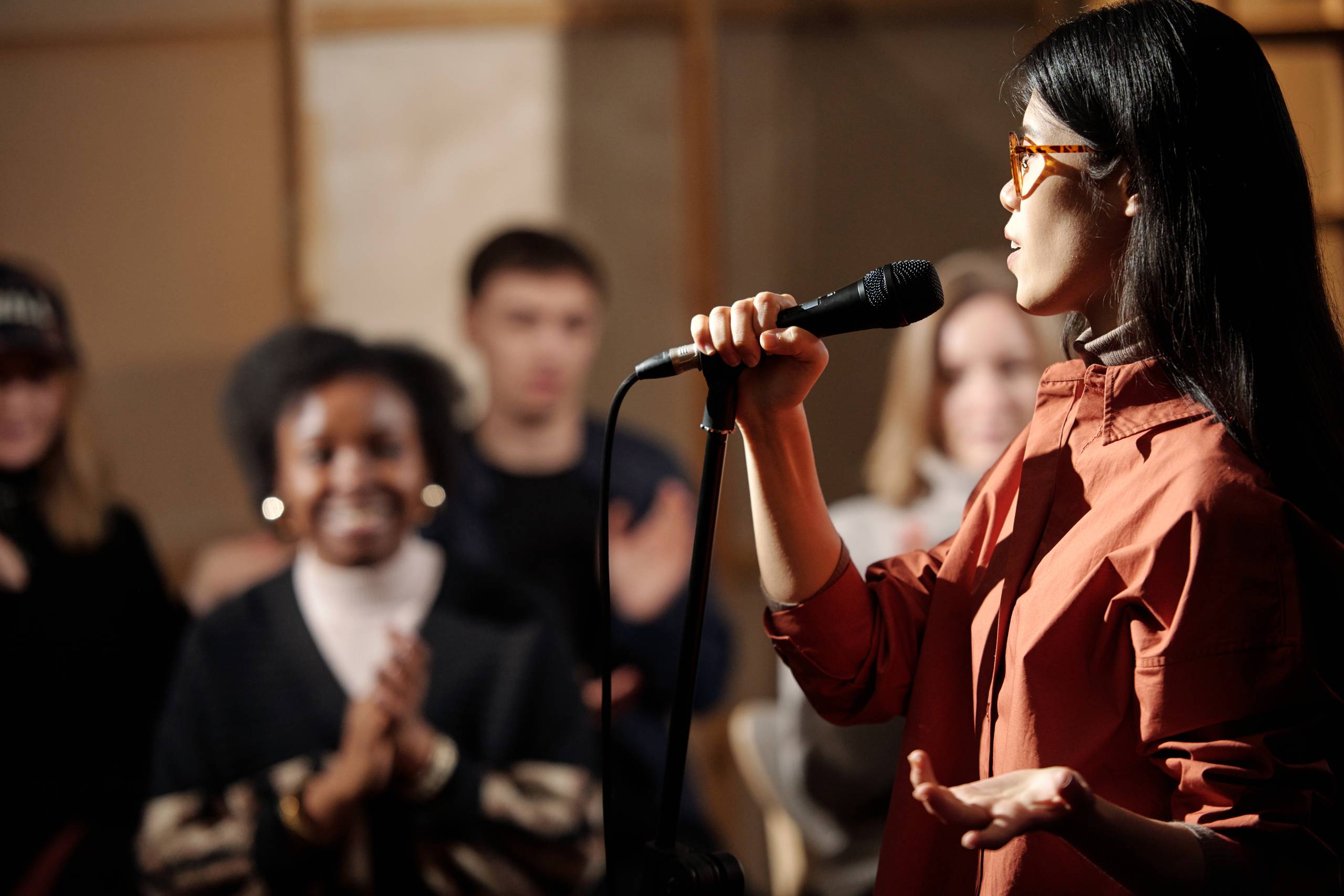
Phrasing is the most important aspect of what sets a good singer apart from an extraordinary singer. It is what makes a singer’s voice a real musical instrument. In classical singing, you learn that just because it’s notated in the sheet music does not mean you can sing the entire phrase through. Every phrase has an impulse, a climax, and a release. The singer’s phrase looks like a bell curve; it builds, it peaks, and then it falls away. This allows the singer to use a bell curve in order to mimic the contours of the speaking voice, but to also stretch it out into something beautiful and musical. By using breaths, dynamics, and the placement of consonants, the singer can build momentum to propel the listener through the music and cause it to feel new even when you know the tune.
But phrasing begins with comprehension of the text in relation to the music. Diction, poetry, rhetorical methods, and other tools help singers gain insight into the significance of every word, every syllable. A good phrasing honors the inherent stresses of the words, and also mirrors the stresses — and releases — of the musical line. Perhaps a suspension of a chord suggests a slight elongation of a phrase, or a chromatic and unexpected chord change demands a slight cooling of the color to intensify the drama of a moment. The singer must imagine the musical line, and think of places to caress and places to push, places to relax and places to rest. Eventually, this process becomes second nature.
With all of the above points in mind, it’s not hard to see how important technical security is to liberating the voice to express. When the breath, resonance, and registers are all functioning well, the singer doesn’t have to think about those things and can devote all their attention to expressing. This in turn means that they can make the tiny expressive adjustments that distinguish one performer from another – tiny shifts in vibrato rate, or tiny scoops or portamenti, or tiny shifts in dynamics. Without that freedom, the phrasing can feel a bit wooden and calculated. With it, it feels like the voice is simply a vehicle for the thought. To develop the musical expression, try singing a scale as if it were a melody – maybe even actually singing a melody! – and varying the dynamics or the emphasis on the text as you sing.
One of the difficulties of learning to phrase is the issue of faithfulness to the text versus being individualistic. Often a singer is first terrified of doing anything other than what is indicated, leading to very square phrasing, or else they go the other direction, doing too much, and completely altering the intent of the composer. You have to keep both in mind. A singer can be made aware of this by listening to different versions of recordings, old and new, that demonstrate different degrees of phrasing within the stylistic parameters. Their teacher will also encourage them to play in the practice room, taking risks and trying new things in order to find out what works for them. Over time, the voice becomes a tool of expression, and each phrase carries with it a sense of confidence and authority.
At its best, beautiful phrasing becomes a shared emotional event between performer and listener. A sensitively phrased musical line can move someone to tears, bring them to contemplation, or make them feel joyful in a way that text alone cannot. It preserves the message of the composer and also gives the listener an idea of who the performer is, which is a private experience even in the biggest concert hall. The shared emotional event of beautiful phrasing illustrates that classical singing is really about communication, and conveying ideas and thoughts that aren’t achievable with the spoken word. The more that singers devote themselves to this lifetime journey, the better they become at touching people with their singing, and leaving behind performances that are remembered long after the performer has walked off the stage.